I hope I have not kept my dear
readers on tenterhooks. I have had a temporary hesitation about writing on any topic other than what is currently happening in the northeastern part of my country, Nigeria. My non-Nigerian readers might not know about it; innocent people, including some promising secondary school students, are being mercilessly massacred in large numbers by the marauding terrorist Islamists called Boko Haram. May Allah have mercy on them, expose and punish their killers. Please
let’s say a big AMEEN.
Yeah, to the NOTHING (II): Today’s Nothing, as its prequel, is something, though partly nothing. Here
we go:
Religion as identity or for indictment?
I have already mentioned how
multi-religious a country India is. Religious identity is crucial here, though it is a damning drawback for many. For instance, most Hindus worship more than 300 million gods and goddesses in their faith. Thus, it’s
very easy for them to pick one from those in the form of a big or small statue, portrait
or any visual rendering to put or paste in the room, office or on the vehicle. Muslims wear a cap; Sikhs wear a turban; Christians wear a cross chain, etc. However, some show solidarity with other religions, with statues or pictures of Hindu deities side by side with those of Sikh gurus, or, rarely, with the Muslim Mecca or crescent and stars.
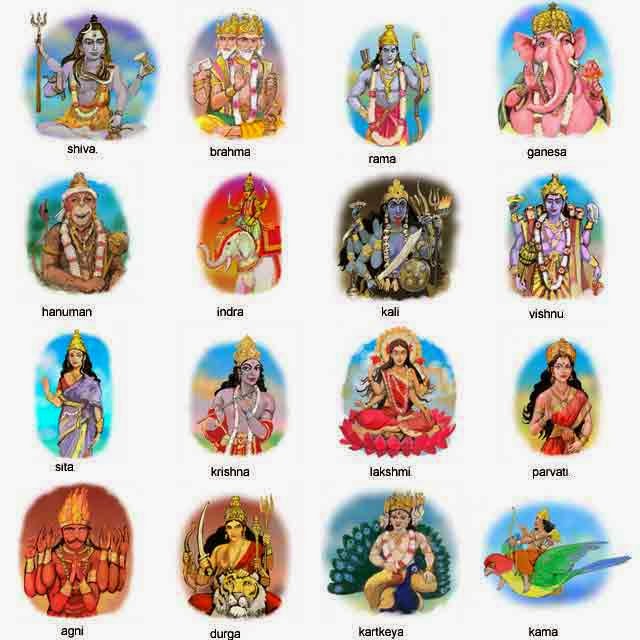
Some Hindu gods and goddesses
It was recently sadly discovered
that religious minorities, or particularly the Muslims, masquerade as Hindus to
sustain their business in India. Some Hindus also complain about marginalisation
in a few other places. But to my personal investigation, some Muslims go to the
extent of ‘renouncing’ their faith to keep their business going in the non-Muslim
dominated areas. There’s also an appalling apartheid in housing where Muslims
are denied rent or many other rights and privileges for their belief. Not only are Muslims discriminated against, but the so-called low-caste Hindus are also victims of this pernicious practice, as some privileges are kept only for the higher castes. Thus, identifying your religion here may make or mar your day.
Love Marriage and Arranged Marriage
“Love marriage or arranged marriage?”
Hmm. My wife was startled by how often we were brusquely asked this question. A reason always triggered it. The practice of arranged marriage, which is more or less
extinct in many places in the world except a few Arab countries and some
less developed parts of Africa, is very much in place in India. We have been
asked this almost everywhere we are seen together. One incident worth recounting occurred during our first days at the University, when my wife came
to fetch me from our department. Her reputation preceded her; therefore, a bevvy of young female students, realising that she was the wife, ‘circled’ us. Apparently fascinated, they asked the often-repeated
question: love marriage? We answered in the affirmative. One shook her head
conspicuously, as if in sadness, and later admitted that none of them knew or could guess her husband. We enquired why, and she said their parents would “decide” who they were. All the guys around you, who you will always see together, are just “school friends/lovers,” and none would dare to bring any of them to their parents.
Graduating at a ‘Tender’ Age
It may sound ironic if I tell you
that while in my M. In a (i.e., Master's) class in Nigeria, I was arguably the
youngest; here I am, unarguably the oldest among the members of the class. A bachelor’s degree is a ‘mere thing’ in India. Besides Engineering, Medical and
para-medical courses, graduation is only for three years, or sometimes less,
and there’s no strike, which always cripple the pace of our university
education in Nigeria. Third, they have many, many more universities and degree-awarding institutions nearby. If your application is rejected by one, it is not
an issue; apply to another, and you shall be admitted. And again, no National Youth Service Corps (NYSC) scheme, which is an additional year for any
graduate in Nigeria. According to recent data, the number of degree holders in
India exceeds the entire population of France. Therefore, doing a second degree, or adding another to the one you have acquired earlier, and even a PhD, doesn’t give them any headache. One of my closest friends is only 22, about the same age as my youngest sister, born in 1993! Although one holds dual degrees and the other an MBA, neither is over 25.
Religion and Conduct are two Different Things
Although each religious followers
are basically taught to love their fellows first, and then others, this does
not warrant you to deny others their rights. Relatively speaking, people should
be wary of whom they entrust. As aforesaid, religious
affiliation is readily figured out in India; take my piece of advice: don’t be
deceived by your religious kin, whichever religion you profess. I have met people of different conduct and of other religions, and lots of drama has ensued in India. But one is worth telling a story of.
Unsuspecting I and my wife were in
New Delhi, the capital of India, for the winter vacation. It was at the end
of the year, i.e. late December. The capital was littered with hurried-looking foreigners
in large numbers, and from far and near. Any non-Indian is (mis)taken as a
tourist by the people around, whatever reasons you were there for
notwithstanding. Therefore, it was an eve of making money—black or white. We were lured to a travel agency by their henchman, who met us immediately after we finished our breakfast in a restaurant filled with foreigners, mostly Europeans. We met a responsible-looking man, obviously a Muslim, who
identified himself. I felt happy. Hmm.
Let me cut it short: after spending
nearly 30 minutes joyously chatting, he collected Rs. 3000 (roughly N9000) from us to take us by bus to the famous Mughal monument, the Taj Mahal, in
Agra, Uttar Pradesh. As it would happen in Nigeria, he assured me that “this is
only for you, brother”. A few minutes later, I was told the bus fare is Rs. 800, with a maximum of Rs. 1000. Breach of trust! We quickly returned to the Agency,
together with an Indian course-mate living near ND. What transpired before I got
my money back is only history, but it was a terrific drama. My wife said she
had never seen me more furious. Police settled the dust. Thanks to them.
Indian English
I ‘am having’ knowledge of it now,
an Indian will very likely tell you instead of the standard “I have”. Thus, I
shall begin the NOTHING (III) from this subhead, in sha Allah. I hope you have found this one
worth reading.
Comments
Post a Comment